Packing lists for a Japan trip rarely mention vaccines — and that's mostly for good reason. Unlike destinations that require proof of specific immunizations before you're allowed in, Japan doesn't impose blanket vaccination requirements on most international visitors. That said, "not required" isn't the same as "not worth thinking about." Between routine immunizations, a few Japan-specific travel recommendations, and questions foreigners often have about accessing vaccines like HPV once they're actually living here, there's more useful information than the average traveler realizes.
This guide covers what's actually required to enter Japan, what's recommended but optional, how families and long-term residents should think about catch-up vaccinations, and how foreigners can access the HPV vaccine in Japan if it's not something they got before arriving.
Do I Need Vaccinations to Go to Japan?
For the vast majority of travelers, no specific vaccination is legally required to enter Japan. There's no vaccine certificate checked at immigration for most nationalities arriving from most countries. The one notable exception: if you're arriving from a country where yellow fever is endemic, proof of yellow fever vaccination may be requested, consistent with international health regulations most countries follow. If that doesn't apply to your travel history, you generally won't be asked for any vaccination documentation at all.
That said, "not required" and "not recommended" are two very different things — which is where the next section comes in.
What Do US Citizens Need to Enter Japan?
For American travelers specifically, entry into Japan for short-term tourism (up to 90 days) generally requires:
- A valid passport
- No visa for short tourist stays, under Japan's visa waiver arrangement for U.S. citizens
- No vaccination proof, under standard circumstances as described above
Beyond entry paperwork, most of the "what do I need" question is really about staying healthy during the trip — which is where travel vaccine recommendations become genuinely useful, even though they aren't mandatory.
Japan Travel Vaccine Requirements: What's Recommended (Even Though Not Mandatory)
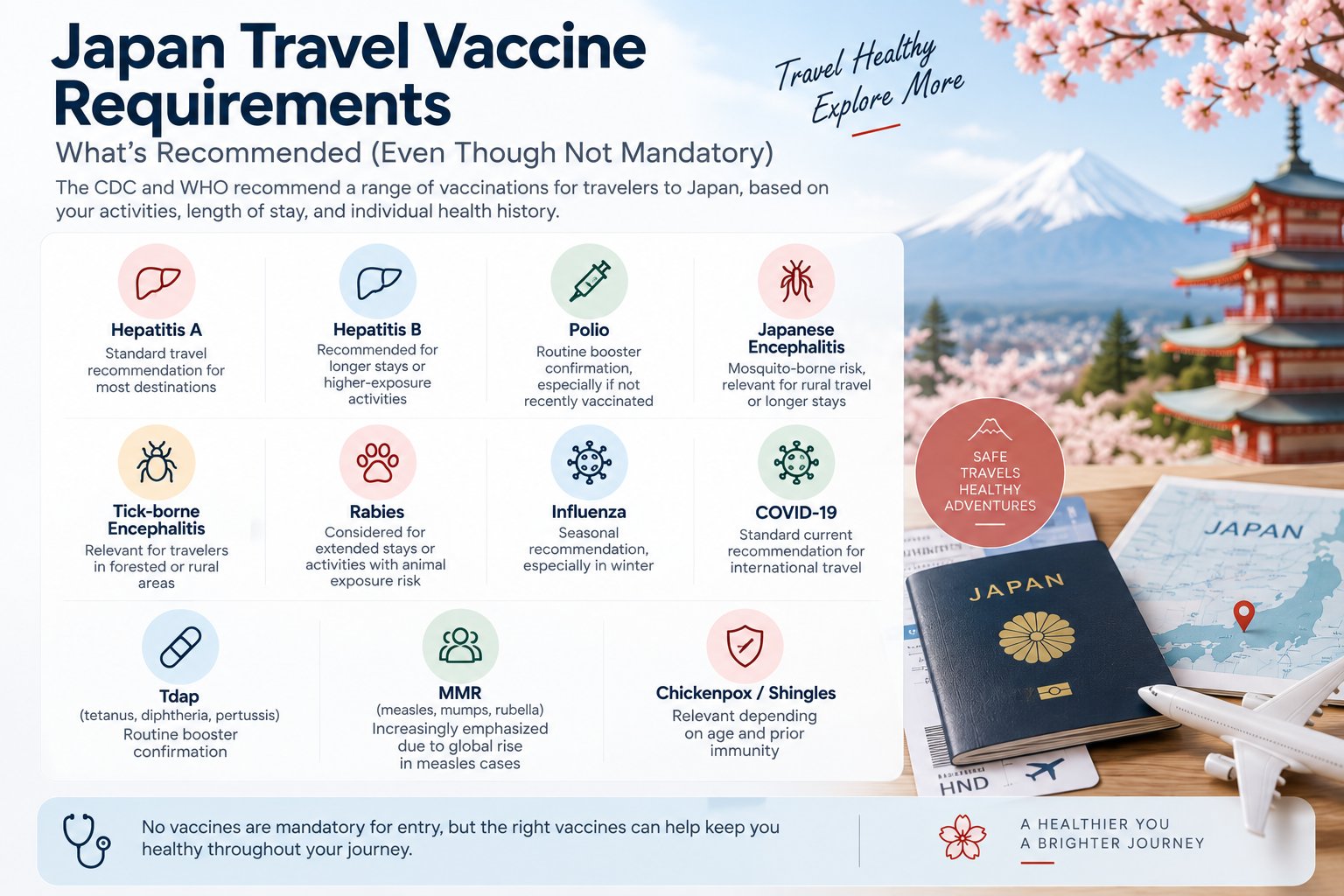
The CDC and WHO recommend a range of vaccinations for travelers to Japan, based on activities, duration of stay, and individual health history rather than a blanket entry rule. Commonly recommended vaccines include:
Vaccine | Why It's Recommended |
Hepatitis A | Standard travel recommendation for most international destinations |
Hepatitis B | Recommended for longer stays or higher-exposure activities |
Polio | Routine booster confirmation, especially for those without recent boosters |
Japanese encephalitis | Mosquito-borne risk, particularly relevant for rural travel or longer stays |
Tick-borne encephalitis | Relevant for travelers spending time in forested or rural areas |
Rabies | Considered for extended stays or activities with animal exposure risk |
Influenza | Seasonal recommendation, especially during Japan's winter months |
COVID-19 | Standard current recommendation for international travel |
Tdap (tetanus, diphtheria, pertussis) | Routine booster confirmation |
MMR (measles, mumps, rubella) | Increasingly emphasized due to a global rise in measles cases |
Chickenpox / Shingles | Relevant depending on age and prior immunity |
None of these are required for entry — they're framed as protective recommendations, and which ones actually apply to you depends on your age, health history, itinerary, and length of stay. A pre-travel consultation with a travel medicine provider a few weeks before departure is the most reliable way to sort out which of these actually matter for your specific trip.
A Note on Measles (MMR)
This one deserves particular attention right now. With measles cases rising in many countries around the world, the CDC has emphasized that all international travelers should be fully vaccinated against measles with the MMR vaccine before departure — regardless of destination. If it's been a while since you've confirmed your own MMR status, it's worth checking before any international trip, Japan included.
A Note on Japanese Encephalitis
Japanese encephalitis is transmitted by mosquitoes and is present throughout much of Asia, including Japan, with outbreaks having occurred in urban centers in recent years even though risk is generally considered higher in rural areas. Vaccination remains the most effective protection — an inactivated Vero cell culture-derived vaccine (IXIARO) was licensed by the FDA in 2009 for travelers 2 months of age and older — and it's worth discussing with a travel medicine provider if your trip includes rural areas, an extended stay, or repeated visits to Japan
Vaccinations for Long-Term Residents and Families
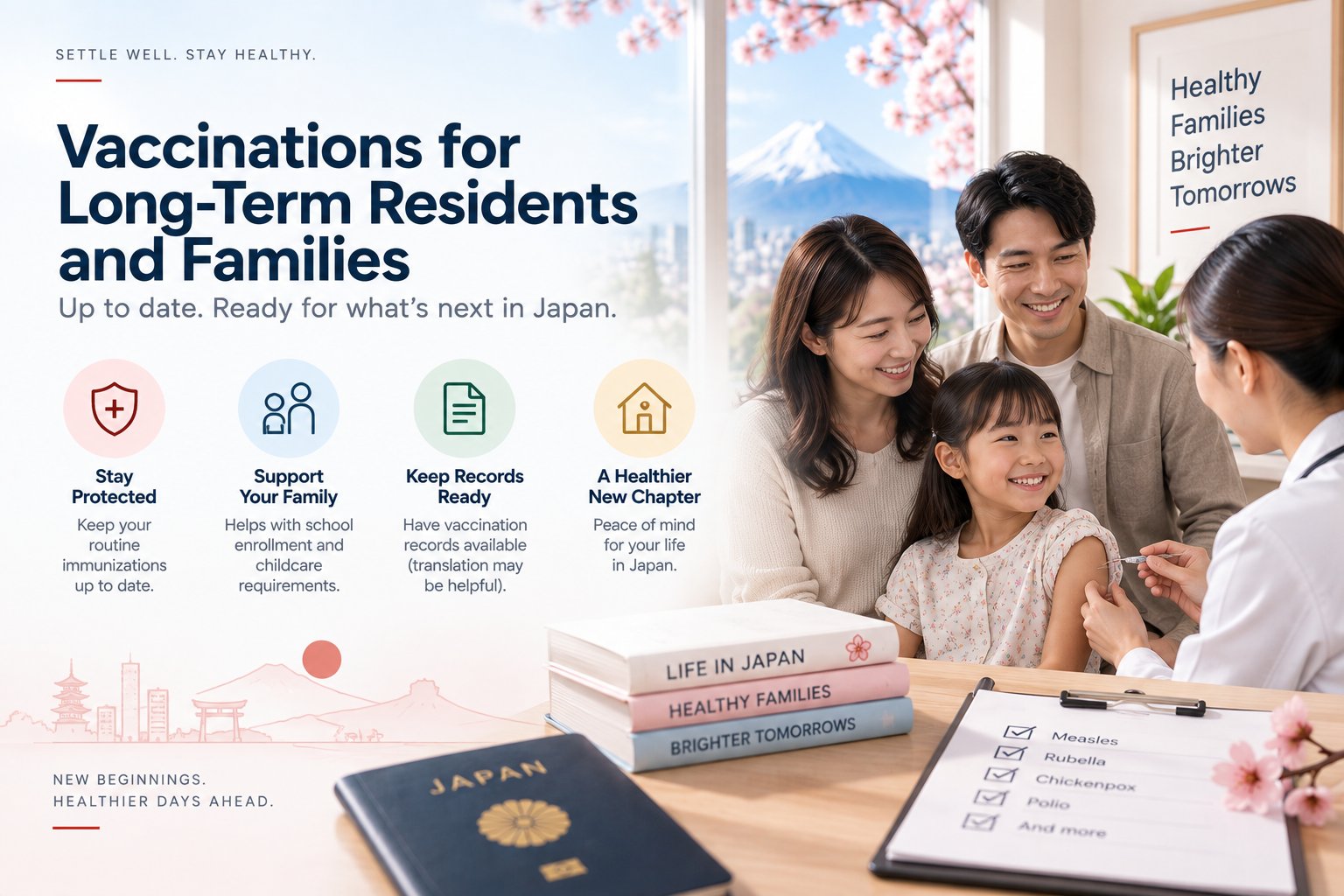
If you're relocating to Japan rather than just visiting, the vaccine conversation shifts from "travel protection" to "routine catch-up." Japan's own tourism authority specifically recommends that long-term visitors confirm they're up to date on standard immunizations — including measles, rubella, chickenpox, and polio — particularly if there's any uncertainty about past vaccination history or if you never received a full course as a child.
For families with school-age children, this becomes especially relevant: Japanese schools and childcare facilities often expect documentation of routine immunizations, and having clear records translated or readily available smooths the enrollment process considerably.
HPV Vaccine in Japan for Foreigners
This is one of the more specific questions international residents ask, and it's worth a direct answer.
Japan has integrated the HPV vaccine into its national immunization program, providing free vaccination to eligible age groups (broadly, girls and young women in a specific school-age and catch-up window) through municipal programs, funded publicly. If you or your child fall outside that specific eligible window — which is common for foreign residents who arrive in Japan partway through that age range, or adults well beyond it — the vaccine is still available, just on a private, self-pay basis.
Private clinics across Japan, including gynecology and international-patient-focused practices, commonly offer the vaccine to a broader age range than the free public program covers — some, like Tokyo Midtown Clinic, extend eligibility to anyone aged 16 and older. Three vaccine types are available in Japan: the 2-valent (Cervarix), 4-valent (Gardasil), and 9-valent (Silgard 9) versions, with the 9-valent option covering approximately 90% of the HPV types that cause cervical cancer. A full course is typically three doses spread across about six months (an initial dose, a second around two months later, and a third around six months after the first).
Pricing for the private, self-pay route varies by clinic and vaccine type, but budgeting for the full three-dose series — rather than a single shot — is important when planning either the cost or the schedule, since the doses are spaced out over roughly half a year.
Where to Get Vaccinated in Japan as a Foreigner
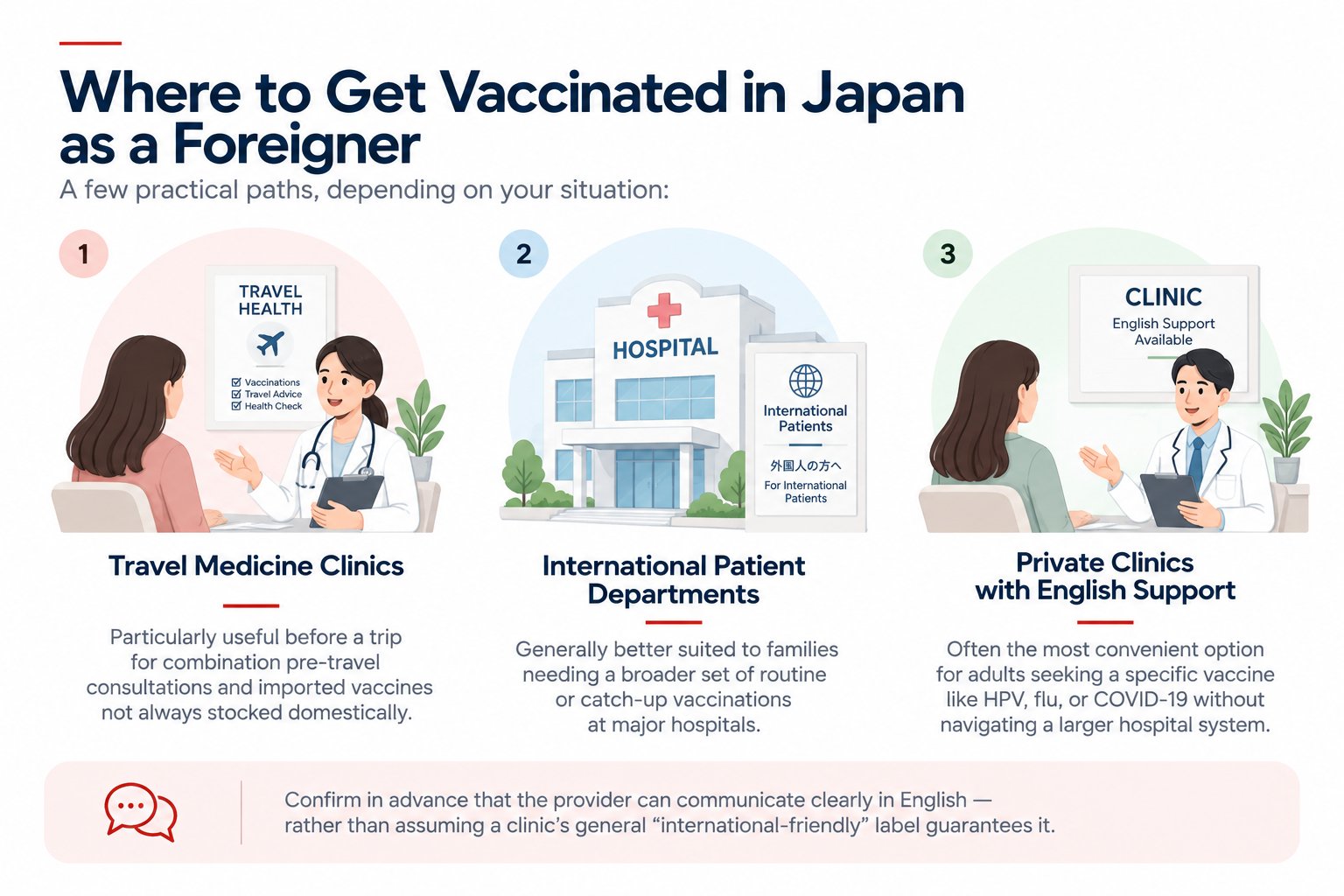
A few practical paths, depending on your situation:
- Travel medicine clinics, particularly useful before a trip for combination pre-travel consultations and imported vaccines not always stocked domestically
- International patient departments at major hospitals, generally better suited to families needing a broader set of routine or catch-up vaccinations
- Private clinics with English support, often the most convenient option for adults seeking a specific vaccine like HPV, flu, or COVID-19 without navigating a larger hospital system
Whichever route you choose, confirming in advance that the provider can communicate clearly in English — rather than assuming a clinic's general "international-friendly" label guarantees it — saves a lot of confusion, especially for something scheduled across multiple visits like the HPV series.
Red Maple Clinic: Travel Medicine and Vaccination Support
Red Maple Clinic, with locations in Tokyo's Bashamichi area and Yokohama, offers travel medicine and imported vaccine consultations as one of its headline services, particularly at the Yokohama location — relevant if you're preparing for a trip and want vaccines not commonly stocked at general domestic clinics. The clinic also offers combined COVID-19 and flu vaccinations, alongside multilingual support for international patients. You can learn more about the physician behind the practice, Dr. Kurenai Takebayashi, on the doctors page, and see the full range of services on the services page.
Frequently Asked Questions
Ques. Do I need vaccinations to go to Japan?
Ans. No specific vaccination is legally required for most travelers entering Japan, with the general exception of proof of yellow fever vaccination if arriving from a country where the disease is endemic. Beyond that, vaccines are recommended rather than mandatory, based on your health history, itinerary, and length of stay.
Ques. What do US citizens need to enter Japan?
Ans. A valid passport is required, and short-term tourist stays generally don't require a visa under Japan's visa waiver arrangement for U.S. citizens. No vaccination proof is required under standard circumstances.
Ques. What are Japan's travel vaccine requirements?
Ans. There aren't mandatory travel vaccine requirements for most visitors, but CDC and WHO commonly recommend hepatitis A and B, polio, Japanese encephalitis, tick-borne encephalitis, rabies, influenza, COVID-19, Tdap, and MMR, depending on individual circumstances and trip specifics.
Ques. Can foreigners get the HPV vaccine in Japan?
Ans. Yes. Foreigners outside Japan's free national eligibility window can access the HPV vaccine privately at many clinics, typically as a three-dose series over about six months. Pricing and vaccine type (2-valent, 4-valent, or 9-valent) vary by provider.
Ques. Is the measles vaccine important for travel to Japan right now?
Ans. Yes, more than it might have been a few years ago. With measles cases rising globally, health authorities specifically recommend that all international travelers confirm they're fully vaccinated with the MMR vaccine before any international trip, Japan included.
Preparing Without Overthinking It
Vaccination for a trip to or a move to Japan isn't about clearing a hurdle at the border; it's about making sensible, individual decisions based on your own health history and how long you'll be staying. For most short-term visitors, that means a quick pre-travel consultation to confirm routine vaccines are current. For residents and families, it means treating catch-up immunizations and things like the HPV vaccine as a normal part of settling in, not an emergency to sort out.
If you're planning a trip and want to review recommended vaccines, or you're settling into life in Japan and need catch-up immunizations, Red Maple Clinic offers travel medicine consultations and vaccination support with multilingual, English-speaking care in the Tokyo–Yokohama area. Reach out to schedule a consultation whenever it fits your plans.