Moving to Japan, working here on assignment, or simply spending an extended stretch of time in the country raises a question that a single vacation rarely does: who is my doctor going to be? A one-off clinic visit for a cold is one thing. Finding a physician you can rely on for ongoing check-ups, prescriptions, referrals, and the occasional "is this serious?" moment is a different challenge entirely — and it's one that a lot of expats, students, and long-term visitors underestimate until they actually need it.
This guide is about that bigger question: how English speaking doctors in Japan actually fit into the healthcare system, how the insurance side works differently depending on your visa status, how referrals to specialists happen, and how to evaluate a doctor's credentials before you commit to seeing them regularly — whether you're based in Tokyo, Yokohama, Osaka, or connecting with a physician online from somewhere less internationally connected.
Two Very Different Starting Points: Resident vs. Visitor
Before anything else, it's worth separating two situations that get lumped together but actually work quite differently:
- If you're a resident (on a work visa, student visa, or similar), you're generally required to enroll in Japan's public insurance system — either Employee Health Insurance (Shakai Hoken) through your employer, or National Health Insurance (Kokumin Kenko Hoken) if you're not employed by a company that provides it. This typically covers 70% of most medical costs, leaving you responsible for the remaining 30%.
- If you're a short-term visitor or tourist, Japan's public insurance generally doesn't apply to you. In this case, most English-speaking doctors who treat international patients operate on a self-pay basis, with costs settled directly at the clinic and reimbursement pursued afterward through your own travel insurance, if you have it.
Knowing which category you fall into changes almost everything else in this guide — from what a visit costs to what paperwork you'll need.
How Foreigners Actually Access Doctors Across Japan
Contrary to a common assumption, English-speaking medical care isn't confined to a single neighbourhood or a handful of famous international hospitals. It shows up in a few different forms:
- Private clinics catering specifically to international patients, concentrated mainly around Tokyo, Yokohama, Osaka, and other cities with larger foreign populations
- General hospitals with international patient departments, which can arrange interpreters or English-speaking staff, though usually with more process and less flexibility
- Independent English-speaking physicians working within larger practices, sometimes limited to specific specialties
- Telemedicine and online consultations, which have become one of the more practical bridges for residents living outside major cities, or for anyone whose schedule makes an in-person visit difficult
That last option matters more than people expect. If you're based somewhere without a strong international-patient clinic nearby, an online consultation with an English-speaking doctor can often solve the problem entirely — no commute, no waiting room, and the same level of communication clarity.
Understanding Japan's Referral System (Shokaijo)
One thing that catches many foreigners off guard is Japan's referral culture. Larger hospitals — particularly for specialist care — often expect a referral letter (shokaijo) from a smaller clinic or general physician before they'll see you, and visiting without one can mean an additional referral fee or, in some cases, being redirected elsewhere.
This is a strong argument for establishing a relationship with a general English-speaking doctor early, rather than waiting until you need a specialist. A doctor who already knows your medical history can write that referral quickly and in terms the receiving hospital will understand — smoothing out a process that can otherwise feel opaque to newcomers.
How to Evaluate a Doctor's Credentials before Committing
Because this is about an ongoing relationship rather than a single visit, it's worth being a little more selective than you might be for a one-time cold. A few things worth checking:
- Medical qualifications and specialty training — where they studied, what they're board-certified in, and whether their background matches the kind of care you're likely to need.
- Genuine English fluency, ideally confirmed through direct conversation rather than a clinic's marketing copy.
- Range of care offered — general internal medicine is useful as a foundation, but relevant experience in areas like travel medicine, vaccinations, or preventive care adds real value for internationally mobile patients.
- Consultation flexibility — does the practice offer both in-person and online options, so you're not stuck if you're traveling or unwell enough that a trip to the clinic is unappealing.
- Transparency around cost and process, particularly for self-pay patients who want to know what they're agreeing to before treatment starts.
National Insurance vs. Self-Pay: A Side-by-Side Look
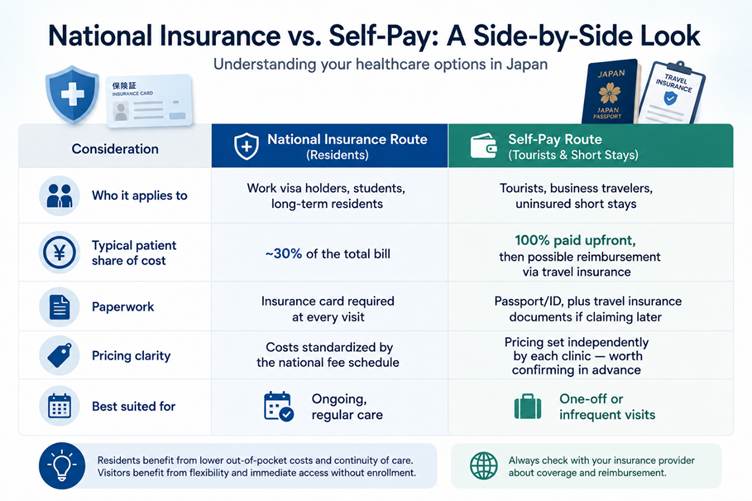
Consideration | National Insurance Route (Residents) | Self-Pay Route (Tourists & Short Stays) |
Who it applies to | Work visa holders, students, long-term residents | Tourists, business travelers, uninsured short stays |
Typical patient share of cost | ~30% of the total bill | 100% paid upfront, then possible reimbursement via travel insurance |
Paperwork | Insurance card required at every visit | Passport/ID, plus travel insurance documents if claiming later |
Pricing clarity | Costs standardized by the national fee schedule | Pricing set independently by each clinic — worth confirming in advance |
Best suited for | Ongoing, regular care | One-off or infrequent visits |
What Does It Actually Cost?
For residents using Japan's national health insurance, your out-of-pocket share (typically around 30% of the total consultation cost) often makes routine medical visits relatively affordable.
For tourists and short-term visitors seeking care at Red Maple Clinic, consultations are available under the following pricing structure:
- Consultation Fee: ¥33,000
- Consultation + Prescription: ¥55,000
Please note that walk-in consultation fees are determined at the clinic based on the patient's diagnosis and treatment requirements, so a fixed price cannot be provided in advance.
If additional laboratory tests, imaging, specialist referrals, or medications are required beyond the consultation, these may incur separate charges. Patients are encouraged to confirm any additional costs with the clinic before treatment.
This transparent pricing helps international patients understand what to expect while ensuring they receive comprehensive English-speaking medical care in Japan.
Red Maple Clinic: A Look at One English-Speaking Practice
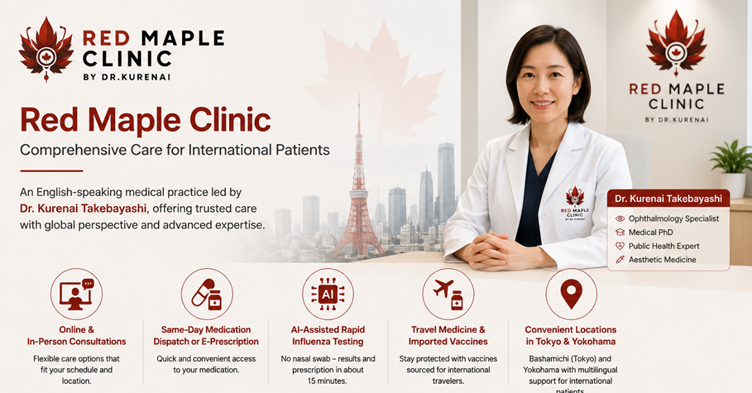
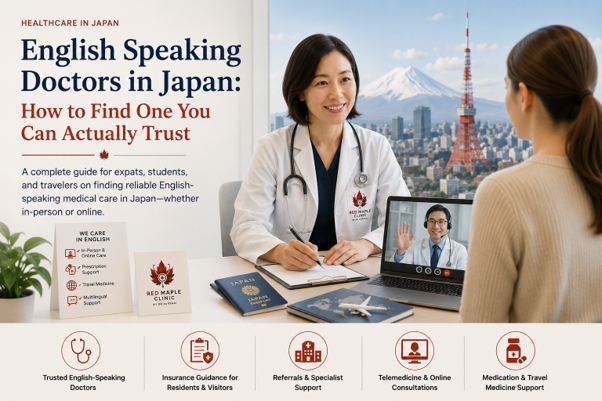
Red Maple Clinic is a useful reference point for what a well-rounded, foreigner-friendly practice looks like. It's led by Dr. Kurenai Takebayashi, whose background spans ophthalmology, a medical PhD, public health work, and aesthetic medicine — a combination that reflects the kind of broad clinical grounding worth looking for in a doctor you plan to see more than once. Her full background is detailed on the doctors page.
A few features of the practice illustrate points raised earlier in this guide:
- Both online and in-person consultations, useful if you're weighing telemedicine against an in-person visit
- Same-day medication dispatch or e-prescription to a nearby pharmacy, reducing the friction of a follow-up trip
- AI-assisted rapid influenza testing, avoiding the nasal swab and moving from test to prescription in about 15 minutes
- Travel medicine and imported vaccines, particularly relevant if you're the kind of patient who splits time between countries
- Locations in Tokyo's Bashamichi area and Yokohama, with multilingual support built around international patients specifically
More detail on what's offered is available on the services page, and information on continued support is covered under medical assistance.
Building a Better Long-Term Healthcare Setup in Japan
- Don't wait for an emergency to find a regular doctor. Establishing the relationship before you need a referral saves time when it actually matters.
- Confirm your insurance category early — resident insurance and self-pay work differently, and assuming the wrong one can lead to unexpected costs.
- Keep a running English-language health record — medications, allergies, past diagnoses — so any new doctor, in Japan or elsewhere, can get up to speed quickly.
- Don't rule out telemedicine. For non-urgent concerns, an online consultation with an English-speaking doctor is often just as effective as an in-person visit, without the travel time.
- Ask directly about specialist referral support if you have a condition that might eventually need one — it's easier to ask this before you need it than during a stressful moment.
Frequently Asked Questions
Ques. How can I find an English-speaking doctor if I'm not living in Tokyo or Yokohama?
Ans. Telemedicine has made this considerably easier than it used to be. Many English-speaking practices now offer online consultations, which means location matters less than it once did — you can often get a prescription or medical guidance without needing a clinic nearby.
Ques. Do I need Japanese national health insurance to see an English-speaking doctor?
Ans. No. It depends on your status. Residents on a visa are generally required to enroll in national insurance, which covers roughly 70% of costs. Tourists and short-term visitors typically aren't covered by this system and instead pay directly at self-pay clinics, later claiming reimbursement through travel insurance if applicable.
Ques. What's the difference between seeing a general doctor and going straight to a specialist?
Ans. Japan's healthcare system often expects a referral letter from a general physician before a specialist or larger hospital will see you. Building a relationship with an English-speaking general doctor first makes that referral process faster and clearer if a specialist becomes necessary later.
Ques. Are online consultations with English-speaking doctors in Japan reliable?
Ans. Yes, for a wide range of non-emergency situations. Online consultations can cover general symptoms, prescription renewals, and follow-up care, and pricing is often similar to or lower than an in-person visit. For anything urgent or requiring physical examination, an in-person visit remains the right call.
Ques. How do I know if a doctor's English is actually good enough?
Ans. Clinic marketing doesn't always reflect reality. It's worth having a short initial conversation — by phone, message, or an introductory consultation — before committing to ongoing care, particularly if you'll be relying on that doctor for anything beyond routine check-ups.
Finding a Doctor Worth Sticking With
Choosing an English-speaking doctor in Japan is less about finding someone for a single appointment and more about building a relationship you can rely on — for prescriptions, referrals, and the kind of ongoing care that comes with actually living somewhere. Taking the time to understand your insurance category, check credentials, and consider both in-person and telemedicine options puts you in a much stronger position than searching for help only once you're already unwell.
If you're looking for a physician-led practice that combines multilingual support with both online and in-person care in the Tokyo–Yokohama area, Red Maple Clinic is worth reaching out to — whether you need a one-time consultation or you're looking to establish ongoing care during your time in Japan.