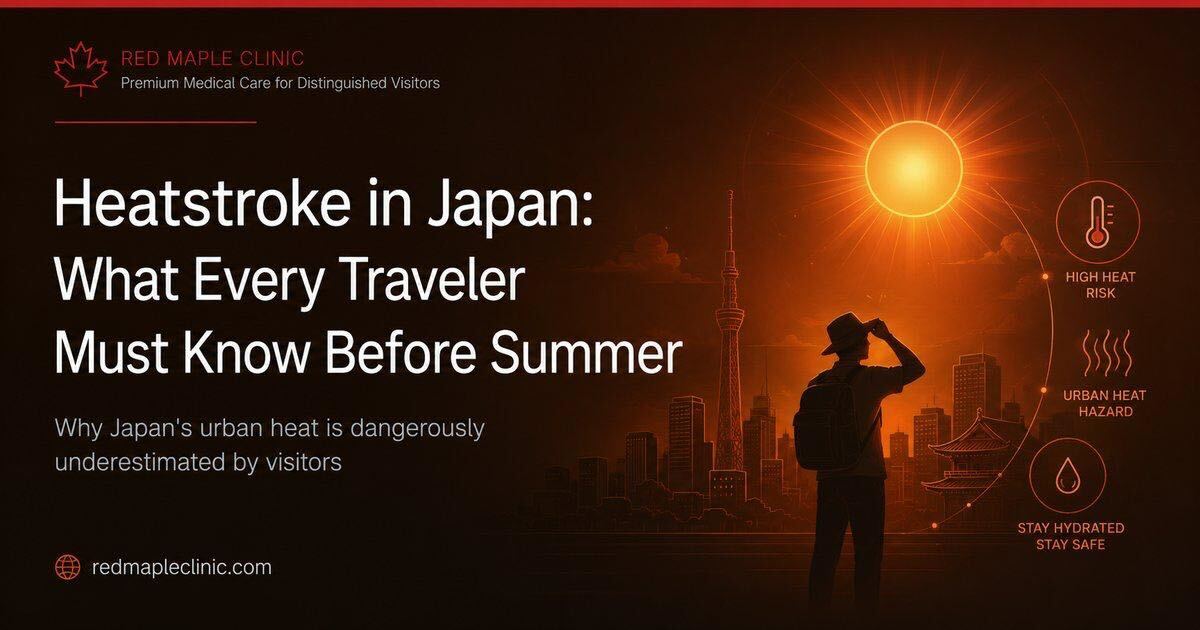
Why Japan's urban heat is dangerously underestimated by visitors and how to stay safe
A Health Emergency Hiding in Plain Sight
Every summer, tens of thousands of people across Japan are hospitalized for heatstroke. In recent years, that number has exceeded 70,000 emergency transports in a single season — a figure that continues to climb as summers grow hotter. Yet most international visitors arrive in Tokyo, Yokohama, Osaka, or Kyoto with virtually no awareness of this risk.
For distinguished travelers accustomed to warm climates — whether Dubai, Singapore, or Southern California — Japan's summer temperatures may appear manageable on paper. Thirty-five degrees Celsius sounds tolerable. What the numbers do not convey is the extraordinary humidity that transforms Japan's cities into open-air saunas, overwhelming the body's cooling mechanisms in ways that dry heat simply cannot.
This article provides the context and actionable strategies you need to protect yourself and your traveling companions during Japan's most beautiful — and most physiologically demanding — season.
Why Japan's Urban Heat Is Uniquely Dangerous
The concrete jungle amplification effect
Tokyo and Osaka are among the most densely built urban environments on earth. Vast expanses of concrete, asphalt, and glass absorb solar radiation throughout the day and radiate it back well into the evening. This urban heat island effect elevates city temperatures 3–5°C above surrounding rural areas. Walking through Shinjuku or Umeda at 2 PM, the effective ground-level temperature can exceed 40°C (104°F).
Humidity: the invisible multiplier
Japan's summer humidity regularly exceeds 80%. At this level, sweat — the body's primary cooling mechanism — cannot evaporate efficiently. Your core temperature rises even when you feel like you are perspiring heavily. This is fundamentally different from dry heat environments, where evaporative cooling provides substantial relief.
The heat index — what the temperature actually "feels like" when humidity is factored in — frequently reaches 45–50°C (113–122°F) in central Tokyo during July and August. At these levels, heatstroke can develop within 30 minutes of unprotected outdoor exposure.
The indoor-outdoor thermal shock cycle
Japan's buildings, trains, and taxis are aggressively air-conditioned, often to 22–24°C. Stepping from a frigid department store into 38°C humidity creates a thermal shock that strains the cardiovascular system. Repeated cycling between extremes throughout a day of sightseeing or business meetings accelerates fatigue and fluid loss.
Who Is Most at Risk?
While heatstroke can affect anyone, certain groups face significantly elevated danger:
Recognizing Heatstroke: The Warning Signs That Demand Immediate Action
Stage 1: Heat exhaustion (act now to prevent escalation)
Stage 2: Heatstroke (medical emergency)
If someone exhibits Stage 2 symptoms, call emergency services (119 in Japan) immediately and begin active cooling.
Prevention: A Strategic Approach for the Informed Traveler
1. Restructure your daily schedule
The most dangerous hours are 11 AM to 3 PM. Schedule outdoor sightseeing, temple visits, and garden tours for early morning (before 10 AM) or late afternoon (after 4 PM). Use the midday hours for indoor museums, shopping, spa treatments, or hotel rest.
2. Hydrate proactively — not reactively
By the time you feel thirsty, you are already mildly dehydrated. Aim for 250–300 mL of water every 30 minutes during outdoor activity. Japan's ubiquitous vending machines and convenience stores make this effortless — look for drinks labeled with electrolytes (Pocari Sweat and Aquarius are local favorites specifically formulated for heat recovery).
3. Master the art of strategic cooling
Japan has developed a sophisticated culture of heat management. Take advantage of it:
4. Dress for the climate, not the occasion
For business travelers: consider lightweight, breathable fabrics and looser fits. Many Japanese executives now adopt "cool biz" — lighter attire during summer months. Your Japanese counterparts will understand and likely appreciate the cultural awareness.
For leisure travelers: light-colored, moisture-wicking clothing, a quality UV-protective hat, and proper sunscreen (SPF 50+ is standard in Japan) are non-negotiable.
5. Monitor alcohol and caffeine intake
Both are diuretics that accelerate dehydration. An evening of sake or craft beer — while a delightful cultural experience — requires compensatory hydration before sleep and upon waking. Be especially mindful of food safety during summer dining, as dehydration from heat compounded by a foodborne illness creates a particularly dangerous combination.
6. Use technology to your advantage
Japan's weather services issue heat alerts with specific danger indices. The WBGT (Wet Bulb Globe Temperature) index is displayed on many public screens and weather apps. When it shows "Dangerous" (above 31°C WBGT), limit outdoor exposure to essential transit only.
7. Know the location of emergency cooling stations
Many Japanese cities designate public buildings, libraries, and community centers as official cooling stations (hinan basho) during extreme heat. Your hotel concierge can identify those nearest to your planned route.
Emergency Response: What to Do When Heat Overcomes Prevention
Immediate first aid
- Move the person to shade or air conditioning immediately
- Remove excess clothing and apply cold water to skin — especially the neck, armpits, and groin where major blood vessels are close to the surface
- Fan aggressively to promote evaporative cooling
- Offer small sips of cool water if the person is conscious and able to swallow
- Call for medical assistance
Contact Red Maple Clinic
For rapid, English-speaking medical response, instruct your hotel concierge:
"Please call a doctor from RED MAPLE CLINIC immediately."
Our physicians specialize in treating international patients and can provide:
Unlike navigating a Japanese emergency room alone — where wait times can extend for hours and English support may be limited — our concierge medical pathway ensures you receive coordinated, comprehensible care from the first phone call through full recovery.
Planning Ahead: Your Pre-Trip Checklist
Japan in summer is magnificent — the festivals, the cuisine, the energy of its cities. With the right preparation, you can experience all of it safely. And should anything go wrong, you have a medical team that treats you not as a number, but as a guest.
Red Maple Clinic — Premium medical care for distinguished visitors to Japan.