Japan just had its biggest tourism year on record. In 2025, the country welcomed a record 42.7 million international visitors, a jump of more than 15.8% over the previous high of 36.9 million in 2024 — and that number keeps climbing. With that many travelers moving through the country at any given time, it's only natural that a growing number of them will, at some point, need to see a doctor.
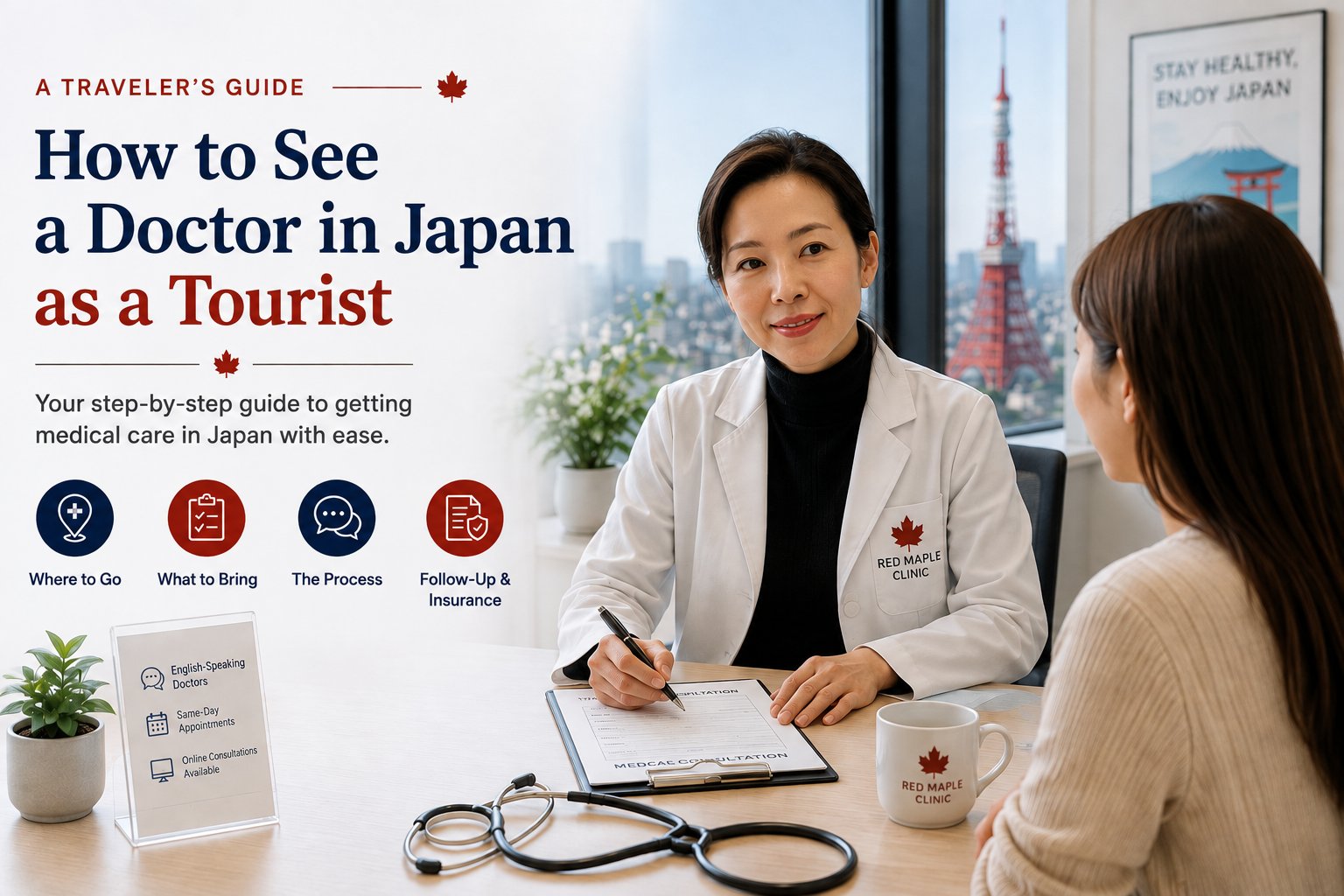
If that happens to you, the good news is that seeing a doctor in Japan as a tourist is far more straightforward than it might feel in the moment. There's a clear path from "I don't feel well" to "I have a diagnosis, a prescription, and a plan" you just need to know the steps. This guide walks through that entire journey, from recognizing that you need care to following up once you're back home.
Step 1: Figure out How Urgent Your Situation Is
Not every symptom needs the same response, and knowing the difference saves you time, money, and stress.
- Mild symptoms (a cold, mild stomach upset, minor cuts) a private clinic or an online consultation is usually enough.
- Moderate symptoms (persistent fever, flu-like symptoms, an injury that needs assessment) — a same-day clinic visit is the right call.
- Severe or emergency symptoms (chest pain, difficulty breathing, major injury, loss of consciousness) — call 119 for an ambulance immediately. Ambulance transport in Japan is generally free of charge, though you're still responsible for the medical costs once you arrive at the hospital.
Sorting your situation into one of these three categories before you do anything else will point you toward the right kind of care immediately.
Step 2: Choose Where to Go — Clinic, Hospital, or Online
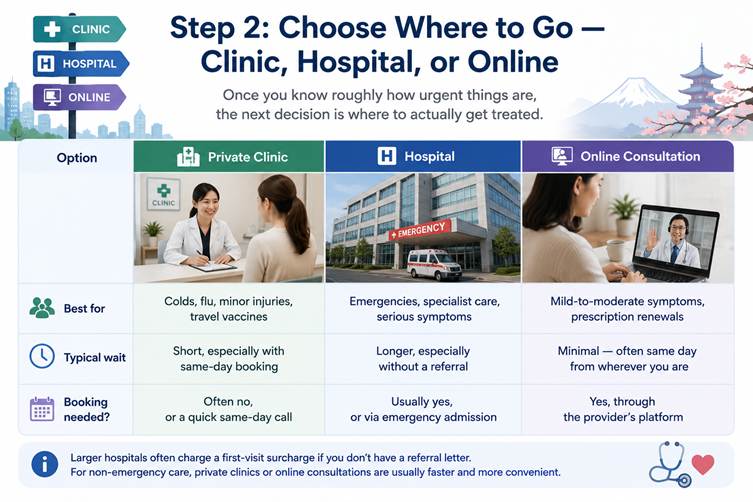
Once you know roughly how urgent things are, the next decision is where to actually get treated.
Option | Best for | Typical wait | Booking needed? |
Private clinic | Colds, flu, minor injuries, travel vaccines | Short, especially with same-day booking | Often no, or a quick same-day call |
Hospital | Emergencies, specialist care, serious symptoms | Longer, especially without a referral | Usually yes, or via emergency admission |
Online consultation | Mild-to-moderate symptoms, prescription renewals | Minimal — often same day from wherever you are | Yes, through the provider's platform |
Larger hospitals in Japan often carry a first-visit surcharge for patients who arrive without a referral letter — a fee around ¥8,800 is common at bigger hospitals for first-time visits without a referral, though the exact amount depends on the hospital's fee schedule. This is one of several reasons a private clinic is usually the faster, simpler option for non-emergency care.
If you're not sure where to start, Japan's official visitor resources are a reliable first stop. JNTO's official guidance for feeling unwell directs travelers toward information on medical institutions and how to access care, and many hospitals and clinics that regularly treat international patients hold JMIP accreditation — a certification system established with the Ministry of Health, Labour and Welfare specifically to evaluate a facility's readiness to accept international patients. You can search that list directly through JNTO's medical institution guide.
Step 3: Prepare What You'll Need Before You Go
A little preparation makes the actual visit much smoother:
- Passport or ID, used for identity verification at almost every clinic
- Travel insurance details, if you have a policy — even if the clinic doesn't bill it directly, you'll need this paperwork for reimbursement later
- A written list of current medications, allergies, and conditions — ideally something you can hand over rather than explain from memory
- A payment method — cards are increasingly accepted at clinics built for international patients, though it's worth confirming beforehand
If you're booking an online consultation instead, you'll typically need the same documents ready digitally, plus a stable internet connection and a quiet space to speak with the doctor.
Step 4: Know What Happens During the Appointment
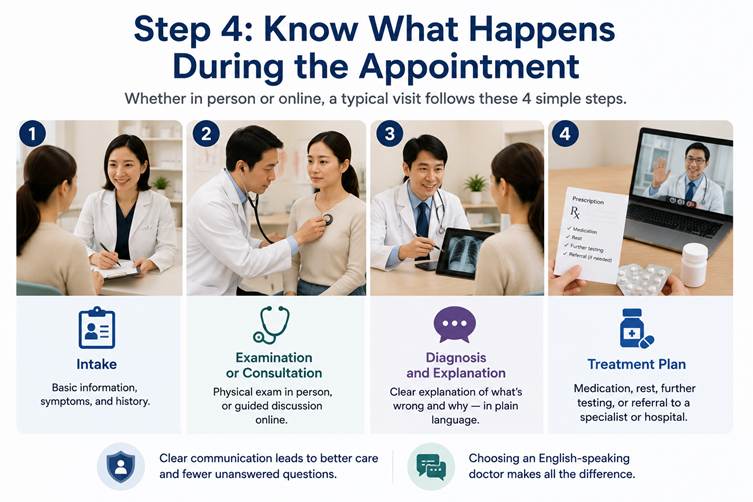
Whether you're at a clinic or connecting online, the structure of a typical visit is fairly consistent:
- Intake — basic information, symptoms, and history, ideally in English if you've chosen an English-speaking provider
- Examination or consultation — a physical exam in person, or a guided symptom discussion for online visits
- Diagnosis and explanation — a clear rundown of what's wrong and why, translated into plain language rather than clinical jargon
- Treatment plan — medication, rest, further testing, or in some cases a referral to a specialist or hospital
The clearer this communication is, the less likely you are to leave with unanswered questions — which is exactly why choosing a genuinely English-fluent provider matters more than it might seem in the moment.
Step 5: Understand What You'll Pay
Most tourists in Japan fall outside the national insurance system, which means care is typically handled on a self-pay basis. You pay the clinic directly and, if your travel insurance covers medical treatment, you can later submit your receipts for reimbursement.
At Red Maple Clinic, there are two consultation options for international patients:
- Consultation Fee: ¥33,000
- Consultation + Prescription: ¥55,000
If additional examinations, diagnostic tests, or treatments are required during a walk-in visit, the final cost will depend on the doctor's diagnosis and recommended care. The clinic will explain any additional charges before proceeding.
For emergency hospital visits, additional hospital fees may apply depending on the facility and whether admission is required.
Step 6: Fill Your Prescription
Japan generally separates the doctor's diagnosis from the pharmacy that fills your prescription, though many clinics built for international patients streamline this by offering:
- Same-day dispatch of medication directly from the clinic
- E-prescriptions sent electronically to a nearby pharmacy, so you can pick it up without extra paperwork
If you're given a printed prescription to take to a separate pharmacy, keep your passport handy it's commonly requested there as well.
Step 7: Handle Follow-Up and Insurance Claims
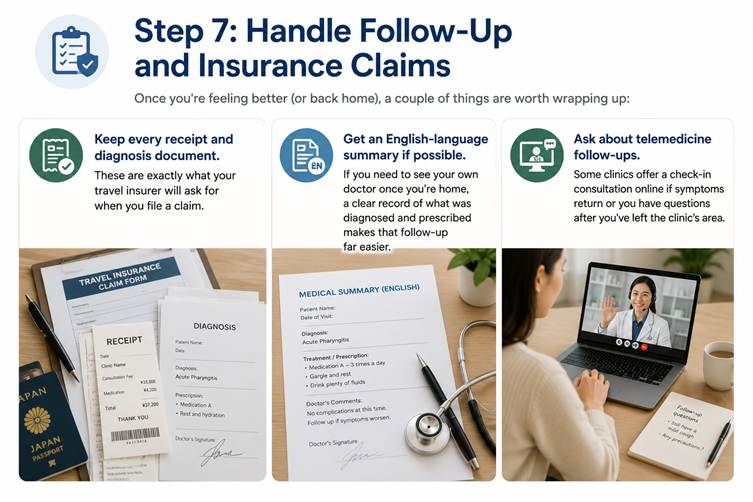
Once you're feeling better (or back home), a couple of things are worth wrapping up:
- Keep every receipt and diagnosis document. These are exactly what your travel insurer will ask for when you file a claim.
- Get an English-language summary if possible. If you need to see your own doctor once you're home, a clear record of what was diagnosed and prescribed makes that follow-up far easier.
Ask about telemedicine follow-ups. Some clinics offer a check-in consultation online if symptoms return or you have questions after you've left the clinic's area.
Where to Turn for Official Help
A few authoritative resources are worth bookmarking before you ever need them:
- JNTO's medical institution guide the tourism board's official directory of hospitals and clinics with foreign-language support, searchable by region and specialty
- JMIP accreditation directory lists facilities certified for their capability to accept international patients
- AMDA International Medical Information Center a multilingual phone consultation service that can help you locate and contact an appropriate facility if you're unsure where to start
These are useful as a backstop, but for many non-emergency situations, a clinic or telemedicine provider built specifically around international patients will get you seen faster.
Red Maple Clinic: An Example along This Journey
Red Maple Clinic, led by Dr. Kurenai Takebayashi, is one example of a practice designed around several of the steps above. Based in Tokyo's Bashamichi area and Yokohama, it offers both in-person and online consultations, which covers Steps 2 and 4 for travelers who'd rather not commute while unwell — or who need care after they've already left the city.
A few specific features map directly onto the journey described in this guide:
- Transparent consultation pricing for international patients: Standard consultation is ¥33,000, while Consultation + Prescription is ¥55,000. If additional tests or treatments are needed during a walk-in visit, the final fee depends on the diagnosis and required medical care.
- Same-day medication dispatch or e-prescription, addressing Step 6 without an extra pharmacy stop
- Travel medicine and imported vaccines, relevant if your visit is about preparing for travel rather than reacting to sudden illness
- Multilingual assistance built specifically for international residents and travelers, easing Step 3 and Step 4
You can find more on the doctors page, and ongoing support options are outlined under medical assistance.
Frequently Asked Questions
Ques. How do I see a doctor in Japan as a tourist?
Ans. Start by judging the urgency of your symptoms, then choose between a private clinic, a hospital, or an online consultation depending on how serious things are. For non-emergency issues, a clinic built for international patients — in person or online — is usually the fastest and clearest path, since it avoids referral requirements and language barriers common at larger hospitals.
Ques. What's it like going to a hospital in Japan as a foreigner?
Ans. It's accessible, but hospitals in Japan often expect a referral for smoother, lower-cost treatment, and English support varies significantly by facility. JMIP-accredited hospitals are built with international patients in mind and are a safer bet if a hospital visit is necessary, particularly for anything beyond routine symptoms.
Ques. How much does it cost to see a doctor in Japan as a tourist?
Ans. Costs vary depending on the clinic and the treatment required. At Red Maple Clinic, international patients can choose between a Consultation Fee (¥33,000) or Consultation + Prescription (¥55,000). If additional diagnostic tests or treatments are required during a walk-in visit, the total cost will depend on the doctor's diagnosis and recommended care. Travel insurance may reimburse eligible medical expenses according to your policy.
Ques. Can I see a doctor in Japan online as a tourist?
Ans. Yes. Online consultations with English-speaking doctors are increasingly common and cover a wide range of non-emergency symptoms, prescription needs, and follow-up care. Pricing is often comparable to an in-person visit, and it removes the need to locate a nearby clinic while traveling.
Ques. What should I bring with me to a doctor's appointment in Japan?
Ans. Your passport, any travel insurance documentation, a list of current medications and allergies, and a payment method. If you're using an online consultation instead, have the same information ready digitally along with a stable internet connection.
Getting the Care You Need, Without Losing a Day of Your Trip
Needing a doctor mid-trip is never part of the plan, but it doesn't have to derail things either. Knowing how to judge urgency, where to go, what to bring, and what to expect turns an intimidating situation into a manageable one usually resolved within the same day.
If you're in the Tokyo or Yokohama area and need accessible, English-speaking care — whether that's a same-day consultation, a travel vaccine before your next stop, or an online visit from wherever you're staying Red Maple Clinic is set up to help. Reach out to book an appointment whenever you need it.
Sources & Further Reading
- JNTO — Guide for When You Are Feeling Ill (Japan National Tourism Organization)
- JMIP — Japan Medical Service Accreditation for International Patients (Japan Medical Education Foundation)
- Nippon.com — Japan Welcomes Record 42.7 Million International Visitors in 2025
- Healthcare Navigation in Japan for Foreigners: A Complete 2026 Guide
- Foreigner-Friendly Hospitals Beyond Tokyo — Japan Handbook